
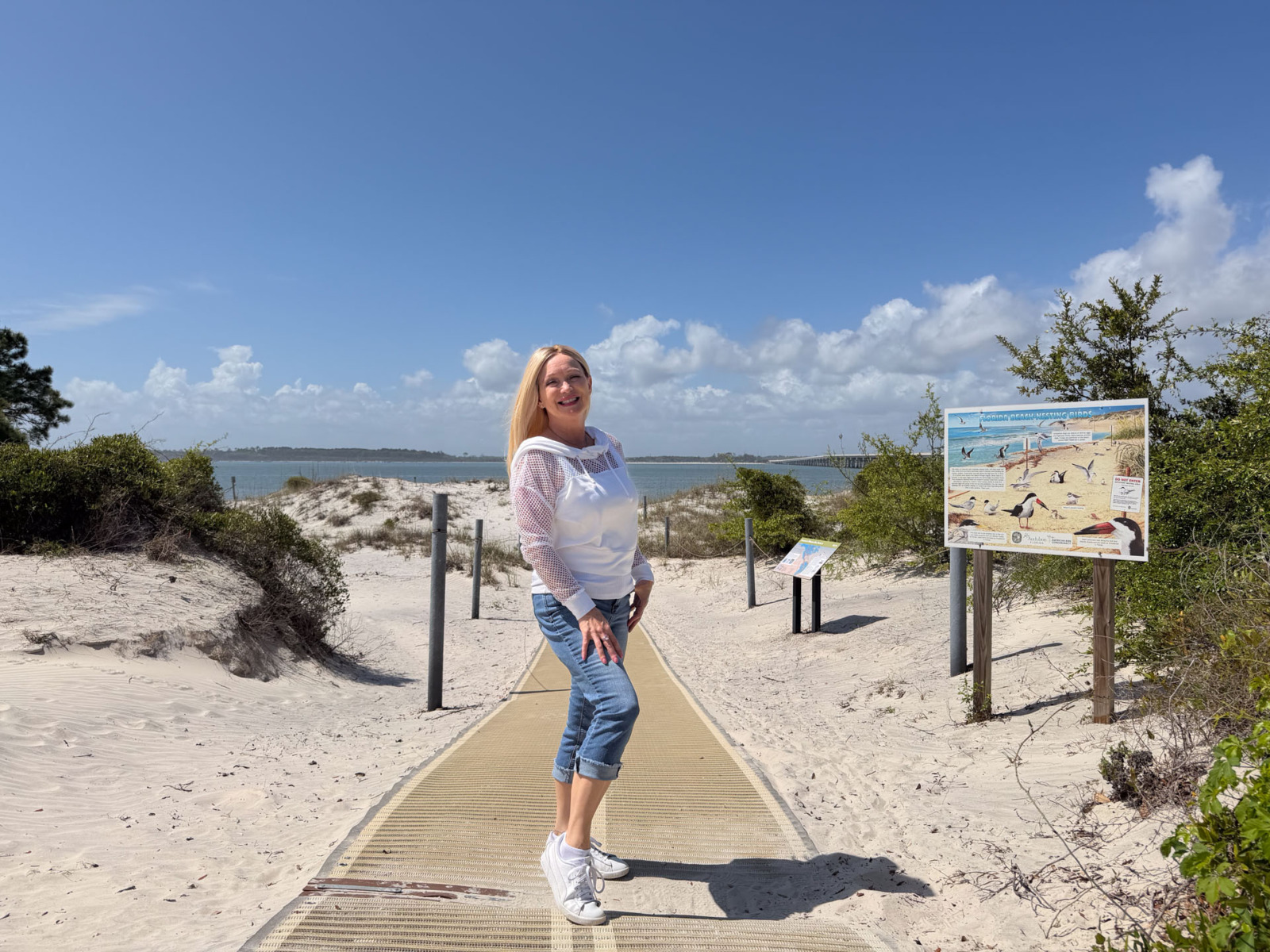
Florida is famous for its beautiful beaches, but getting from the parking lot or boardwalk onto the sand isn’t equally easy for everyone.
For travelers who use wheelchairs, walkers or other mobility devices, soft, deep sand can create a major obstacle between arriving at the beach and actually enjoying it. Fortunately, a number of Florida beaches offer accessibility features that can make a beach day easier. Depending on the location, these may include beach-access mats, accessible boardwalks and ramps, beach wheelchairs, accessible parking and restrooms.
I was reminded of how important these features are while filming Season 2 of Love Eat Travel with Michelle Valentine on Amelia Island, Florida. During our visit, I noticed an accessibility mat providing a firmer path across the sand. It’s the kind of feature many beachgoers may walk past without giving it much thought. But for someone who has difficulty crossing loose sand, accessible beach infrastructure can make an enormous difference.
Here are several wheelchair accessible beaches in Florida to consider, along with some important things to look for when planning an accessible beach day.
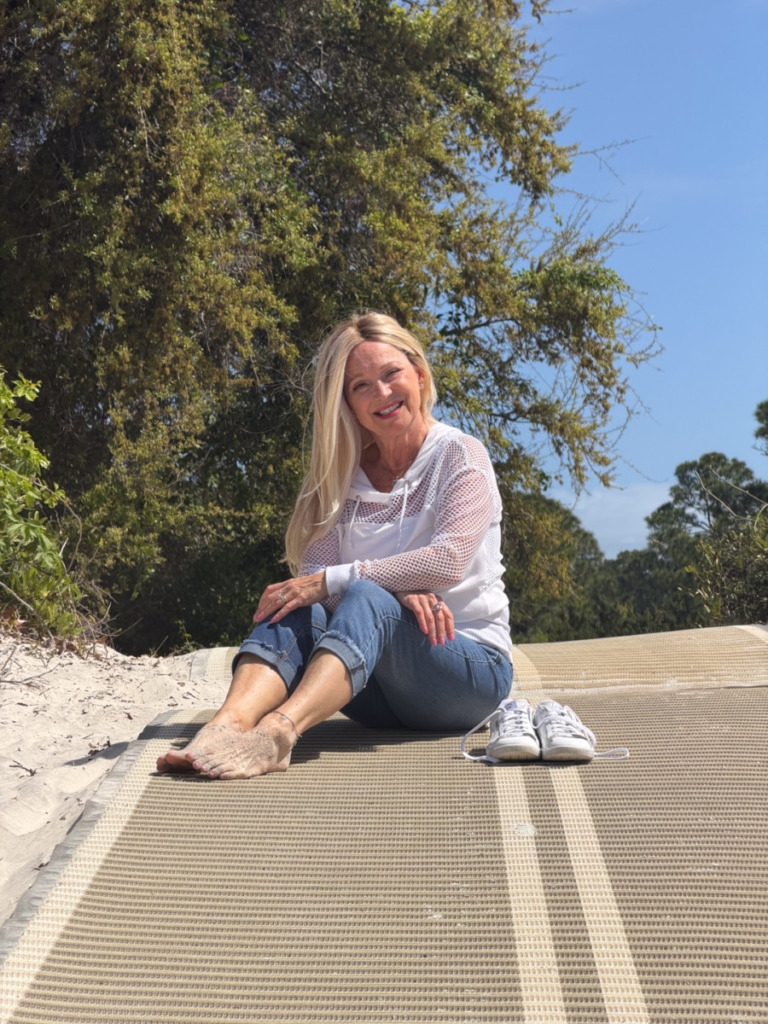
An Accessible Beach Experience on Amelia Island, Florida
While filming our Amelia Island episode of Love Eat Travel with Michelle Valentine, I visited a beach where an accessibility mat extended across the sand. Seeing it in person made me think about beach accessibility differently.
Most of us simply walk from the parking area toward the water without thinking much about the surface beneath our feet. Deep, loose sand can create an entirely different challenge for someone using a wheelchair, walker or other mobility device.
A firm pathway across the sand can help remove one of those barriers and allow more people to experience something many of us take for granted: getting closer to the shoreline and enjoying a Florida beach.
That’s also one of the things I enjoy about traveling while filming Love Eat Travel. Sometimes an experience or something I notice along the way makes me look at a familiar type of destination differently.
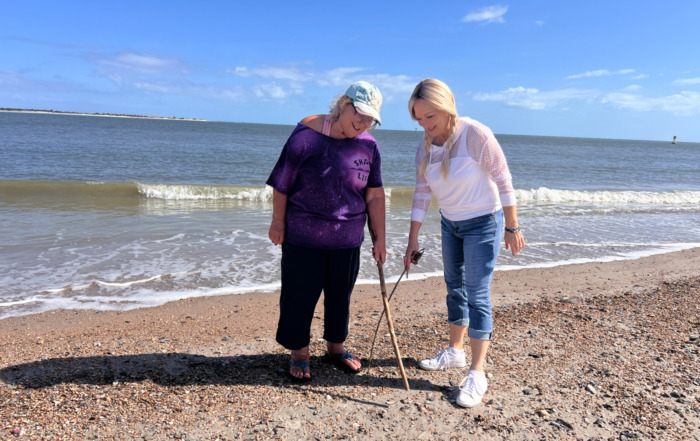
Amelia Island gave me plenty of those moments, from exploring its history and coastal traditions to searching for prehistoric shark teeth along the shoreline.
Explore my Amelia Island, Florida episode of Love Eat Travel with Michelle Valentine.
Clearwater Beach
Clearwater Beach is one of Florida’s best-known Gulf Coast beaches, with miles of sand and the lively Pier 60 area.
For travelers with mobility needs, accessibility isn’t simply about whether a beach has a ramp from the parking area. It’s also important to consider how you’ll actually travel across the sand.
Accessible pathways, beach wheelchairs and nearby accessible facilities can make an enormous difference.
Before visiting Clearwater Beach, check the current accessibility options at the specific beach access you plan to use. Availability of equipment and services can change, so confirming what is available before leaving home is always worthwhile.
Siesta Beach
Siesta Beach on Siesta Key is famous for its beautiful white sand. But that soft sand also illustrates exactly why beach accessibility features matter. What feels wonderful beneath bare feet can be extremely difficult to navigate with a conventional wheelchair or mobility device.
Travelers with mobility needs should look for designated accessible beach entrances, accessible parking and restrooms, and current information about beach-wheelchair availability.
When you’re planning a Florida beach trip, don’t simply research the beach itself. Research the specific beach access you intend to use.
That small distinction can make planning much easier.
South Beach in Miami Beach
Miami Beach’s famous South Beach combines sand, ocean, architecture, restaurants and an almost constant stream of activity. For visitors with mobility needs, beach-access mats can provide a firmer surface over portions of the sand, making the shoreline more accessible than it would be over loose sand alone.
When planning a visit, consider the entire route you’ll need to navigate, not just the sand. Where will you park? Is there an accessible restroom nearby? How far is the accessible beach entrance from where you plan to spend the day? Is specialized beach equipment available?
Thinking through the complete experience beforehand can prevent an unpleasant surprise after you arrive.
Fort Lauderdale Beach
Fort Lauderdale Beach is another popular South Florida destination with a long stretch of Atlantic coastline. The area offers accessibility options for visitors with mobility needs, but as with any beach destination, it’s important to verify the services and equipment currently available before your visit.
If you require a beach wheelchair, don’t assume that having one available somewhere in the destination means one will automatically be waiting when you arrive. Ask where equipment is picked up, whether reservations are required, what hours it is available and whether there are any restrictions.
Planning those details ahead of time leaves more time for what you actually came to Florida to do: enjoy the beach.
Panama City Beach
On Florida’s Panhandle, Panama City Beach offers miles of white sand and Gulf of Mexico views. For travelers with disabilities, the most useful beach access may not necessarily be the one closest to a hotel, restaurant or attraction.
Instead, look for the access point that offers the combination of features you need, such as accessible parking, restrooms, pathways or ramps and beach-wheelchair availability.
A little extra planning before leaving for the beach can make the actual experience considerably easier.
What Makes a Florida Beach Wheelchair Accessible?
The word “accessible” can mean different things at different beaches. A paved parking space near a beach entrance is helpful, but that alone doesn’t necessarily make it possible for someone using a wheelchair to reach the sand or water.
When researching a Florida beach, look for several types of accessibility features.
Beach Access Mats
Beach mats create a firmer surface over loose sand and can make it easier for wheelchairs, walkers and other mobility devices to travel farther onto a beach.
They don’t necessarily extend all the way to the water, and conditions can affect their placement and usability, so check current information before visiting.
Beach Wheelchairs
Specialized beach wheelchairs have larger wheels designed to travel over sand more easily than conventional wheelchairs.
Some Florida communities make beach wheelchairs available at certain locations, sometimes at no charge and sometimes through rental services. Availability may be limited, so reservations or advance arrangements can be important.
Accessible Boardwalks and Ramps
Boardwalks and ramps can make getting from parking areas to beach overlooks or the edge of the sand considerably easier.
Pay attention to where a boardwalk actually ends. A boardwalk that reaches the beach isn’t necessarily the same as a pathway that continues across the sand.
Accessible Parking
Accessible parking is especially important at beaches because some access points can involve long walks from parking areas.
Before visiting, check not only whether accessible parking exists, but also its location in relation to the accessible beach entrance you plan to use.
Accessible Restrooms
Don’t overlook restroom facilities when planning a beach day.
Knowing whether accessible restrooms are available and how far they are from your chosen beach access can be just as important as knowing how you’ll get onto the sand.
Tips for Planning a Trip to a Wheelchair Accessible Beach
Do some research before heading to the beach, particularly if a specific accessibility feature is essential to your visit.
Look for information about beach mats, accessible boardwalks, ramps and beach wheelchairs.
Check accessible parking and restroom locations.
If you need a beach wheelchair, find out whether one needs to be reserved and where it must be picked up and returned.
It’s also worth confirming information shortly before your trip. Equipment availability, beach conditions, construction, storms and maintenance can sometimes affect accessibility.
And don’t be afraid to call the appropriate local beach, parks or visitor office with specific questions.
“Is this beach accessible?” is a broad question.
“Is there a beach-access mat from the accessible parking area onto the sand, and is a beach wheelchair available on the day we’re visiting?” is much more likely to get you the information you actually need.
Accessible Travel Is About More Than Checking a Box
One thing travelers quickly discover is that accessibility is rarely as simple as a destination being labeled “accessible” or “not accessible.” Different travelers have different mobility needs. Someone who can walk short distances with assistance may need something very different from a traveler who uses a wheelchair full time. That’s why detailed information matters.
A photograph of an entrance, the distance from accessible parking, the type of pathway and information about available equipment can be far more useful than a simple accessibility symbol.
The same applies beyond beaches. Cruises, attractions, hotels and transportation all present their own accessibility considerations.
Read my helpful planning tips for cruising with a disabled loved one.
Florida Beaches Can Be for More Travelers
Florida has some of the most beautiful beaches in the United States, and improving access allows more travelers and families to experience them.
My visit to the accessible beach area on Amelia Island reminded me that sometimes a seemingly simple feature, such as a firm pathway across the sand, can make a significant difference. It also reminded me to pay more attention to accessibility features as I travel.
Whether you’re planning a day at Clearwater Beach, Siesta Beach, South Beach, Fort Lauderdale Beach, Panama City Beach, Amelia Island or another Florida shoreline, research the specific beach access before you go.
Find out what is available, confirm the features that matter to you, and plan around the needs of the person you’re traveling with.
A little preparation can make it much easier to concentrate on the best part of a Florida beach day: enjoying the sunshine, water and time together.


Leave A Comment